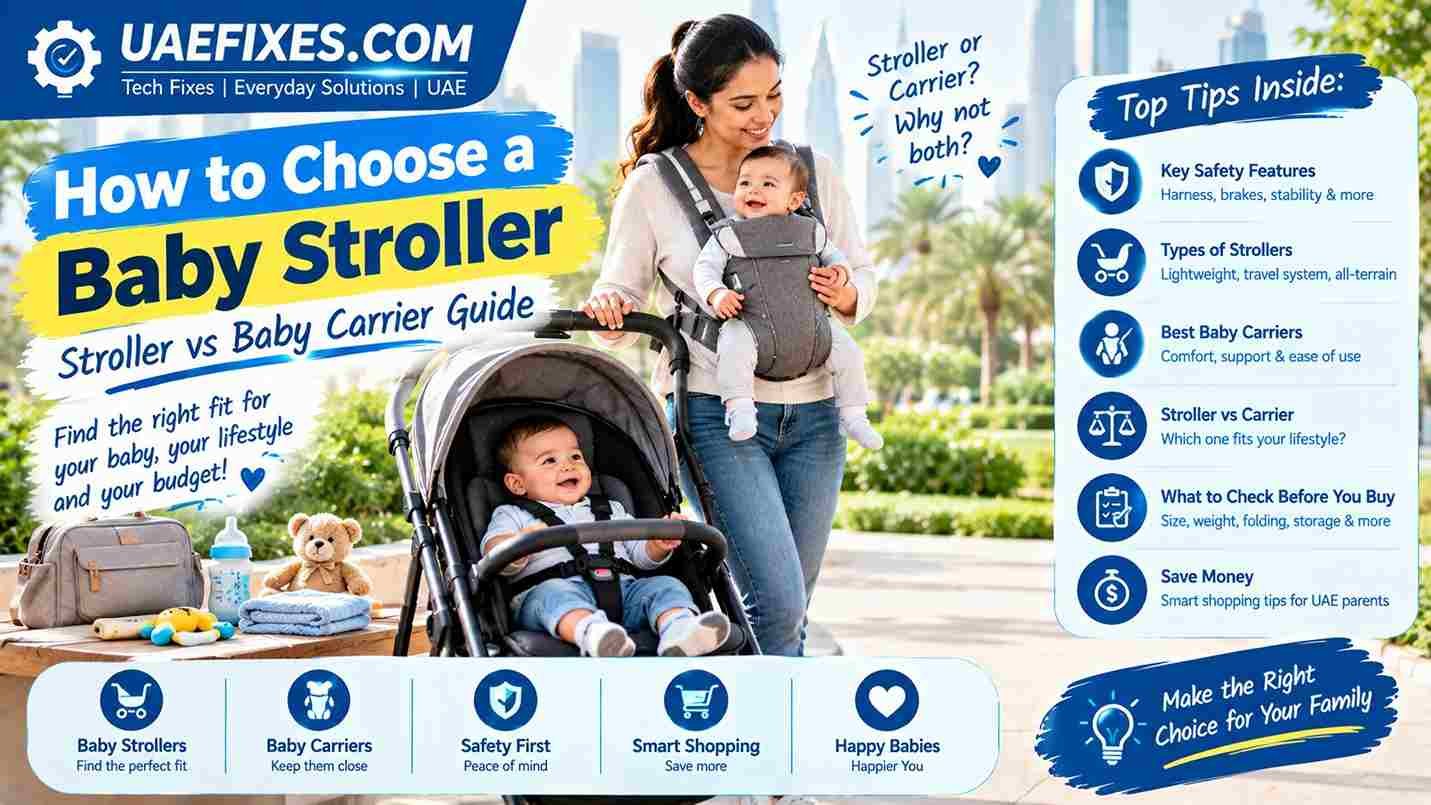
How to Choose a Baby Stroller: A Practical Guide for Parents
Choosing a baby stroller sounds simple until you actually start shopping.
Suddenly, there are lightweight strollers, travel systems, reversible seats, compact strollers, jogging strollers, newborn options, big wheels, small wheels, and enough features to make you wonder whether you need a stroller or a small car.
And then there is the baby carrier.
A carrier can be easier for quick trips, crowded places and keeping your baby close, while a stroller can be much more comfortable for longer outings. So the real question is not just how to choose a baby stroller. It is also knowing when a stroller makes sense, when a baby carrier is useful, and whether you actually need both.
Safety Note
Baby products should never be chosen based on price or appearance alone. Before buying a stroller or baby carrier, check the manufacturer’s age, weight and height limits, safety instructions, harness requirements and product recalls. Never use a stroller or carrier outside the way the manufacturer intended.
For strollers, look for a secure five-point harness, reliable brakes, a stable base and a frame that locks properly when opened. For baby carriers, make sure your baby’s face and airway remain visible and unobstructed, and follow the manufacturer’s instructions for the baby’s size and position.
For more detailed safety guidance, see the American Academy of Pediatrics guidance on strollers and baby carriers. UAEFIXES.COM focuses on practical everyday solutions, but safety instructions from the manufacturer should always come first.
1. Start With Your Baby’s Age
The first thing to check when choosing a baby stroller is not the colour or brand. It is whether the stroller is suitable for your baby’s age and development.
Some strollers are designed for older babies who can sit independently. Others are designed to accommodate newborns using a suitable reclined position, carrycot or compatible attachment.
Always check the manufacturer’s minimum age and weight requirements.
If you are shopping for a newborn, do not assume that a stroller that reclines completely is automatically suitable for newborn use. Check the manufacturer’s instructions.
2. Think About How You Actually Travel
Imagine a normal week.
Are you mostly:
- Walking around your neighbourhood?
- Going to malls?
- Driving everywhere?
- Travelling frequently?
- Using taxis?
- Going to supermarkets?
- Taking long outdoor walks?
- Visiting crowded places?
Your answers can completely change the type of stroller you need.
For example, a large stroller with excellent storage may be wonderful for shopping trips but frustrating if you constantly need to put it into a car.
On the other hand, an ultra-compact stroller may be convenient for travel but provide less storage and cushioning.
The best stroller is usually the one that fits your routine, not the one with the longest list of features.
3. Check the Stroller Weight
A stroller can feel fine in a shop and become surprisingly annoying after carrying it up stairs, lifting it into a car or moving it through an airport.
Before buying, check:
Stroller weight + baby’s weight + anything you normally carry.
If you regularly use a car, lift the stroller yourself if possible.
If you live in a building and need to carry it frequently, a lightweight stroller may be worth paying extra for.
4. Test the Folding Mechanism
One of the most overlooked features is how easily the stroller folds.
Try it yourself.
Don’t just watch a salesperson demonstrate it.
Ask:
- Can I fold it with one hand?
- Does it lock securely when folded?
- Will it fit in my car?
- Can I open it without struggling?
- Is the folded stroller too heavy?
- Does it stand on its own when folded?
A stroller that takes 20 seconds to fold in a shop might feel very different when you are holding a baby, shopping bags and your car keys.
5. Check the Brakes
Good brakes are essential.
Test whether the stroller stays firmly in place when the brakes are engaged.
The brake should be easy for the parent to operate but positioned so that the baby cannot accidentally release it.
Also test the stroller on a slight incline if the manufacturer or store permits it.
6. Look for a Proper Harness
A five-point harness is an important feature to look for.
It should secure the child around the shoulders and hips with a strap between the legs.
Check that:
- The straps adjust properly.
- The buckle closes securely.
- Your child cannot easily release it.
- The harness fits the manufacturer’s instructions.
- There are no damaged or loose straps.
Don’t treat the harness as an optional feature. Use it whenever your child is riding in the stroller.
7. Check Stability Before Buying
Give the stroller a gentle push from different angles.
Does it feel stable?
A wider and well-balanced base can help reduce the chance of tipping.
Also check the storage basket. Avoid hanging heavy shopping bags from the stroller handle unless the manufacturer specifically allows it.
Too much weight in the wrong place can affect stability.
8. Choose Wheels for Your Lifestyle
Small wheels can make a stroller easier to manoeuvre in shops and malls.
Larger wheels may be more useful for uneven outdoor surfaces.
Think about where you normally go.
For example:
Mostly malls and smooth floors:
A compact stroller with smaller wheels may work well.
Outdoor walking:
Look for wheels and suspension suited to the surfaces you use.
Frequent travel:
Prioritize compact folding and manageable weight.
Long daily walks:
Comfort, wheel performance, storage and handle height become more important.
9. Don’t Ignore the Handle Height
This sounds like a small detail until you push a stroller for an hour.
If the handle is too low, a taller parent may constantly bend their back.
If it is too high, another caregiver may find it uncomfortable.
If more than one person will regularly use the stroller, adjustable handle height can be useful.
10. Check the Seat and Recline
Your baby’s comfort matters, but so does the stroller’s intended use.
Check:
- Seat padding
- Recline positions
- Footrest
- Canopy
- Harness adjustment
- Seat width
- Manufacturer’s age and weight limits
If you are buying a stroller for a newborn, pay particular attention to the manufacturer’s approved recline or carrycot configuration.
11. Think About UAE Weather
This is especially important when choosing baby gear in the UAE.
A stroller may spend time moving between air-conditioned malls, cars and hot outdoor areas.
Look for useful features such as:
- A good sun canopy
- Breathable materials
- Adequate ventilation
- A comfortable seat
- Easy-to-clean fabrics
- A rain cover if appropriate for your use
- Storage for essentials
However, don’t cover a stroller with a blanket or fabric in a way that blocks ventilation. The goal is to protect your baby from the environment without creating a hot, poorly ventilated space.
12. Check the Storage Basket
Parents quickly discover that babies require a surprising amount of stuff.
Diapers.
Wipes.
Bottles.
Extra clothes.
Toys.
Snacks.
Shopping.
A useful basket underneath the stroller can make everyday trips much easier.
But check its official weight limit. Bigger storage does not mean you can safely fill it with heavy shopping.
13. Consider a Reversible Seat
Some strollers allow the baby to face the parent or face forward.
A parent-facing position can be useful when you want to keep an eye on a younger baby.
A forward-facing position may be useful as the child becomes more interested in the surroundings.
If this feature matters to you, check how easily the seat changes position. Some designs are much easier to use than others.
14. Do You Need a Travel System?
A travel system may combine a stroller with a compatible infant car seat.
This can be convenient because you can move a sleeping baby from the car to the stroller without transferring them immediately.
But don’t buy a travel system simply because it includes more pieces.
Ask yourself:
Will I actually use everything?
A cheaper stroller that perfectly fits your daily routine can make more sense than an expensive package filled with accessories you rarely use.
Also remember that a stroller is not automatically a substitute for an approved car seat during vehicle travel.
15. What About the Best Baby Carriers?
A baby carrier can be incredibly useful when you don’t want to push a stroller.
It is particularly convenient for:
- Short walks
- Crowded shopping areas
- Travelling
- Airports
- Quick errands
- Situations where stairs make a stroller difficult
- Keeping your baby close
But there is no single best baby carrier for every parent.
The best option depends on your baby’s size, your comfort, the carrier design and how you plan to use it.
16. What to Look for in a Baby Carrier
When comparing a baby carrier, check:
Baby’s size:
Make sure the carrier is approved for your baby’s age, weight and size.
Support:
The carrier should support the baby according to the manufacturer’s instructions.
Airway visibility:
Your baby’s face should remain visible and the nose and mouth should not be covered.
Adjustability:
Different parents may need different strap settings.
Comfort:
Try it with the baby if possible.
Material:
For the UAE, breathable materials can be especially useful for reducing discomfort in warm conditions.
Ease of use:
A carrier that is difficult to put on correctly may end up sitting unused.
17. Baby Stroller vs Baby Carrier
| Feature | Baby Stroller | Baby Carrier |
|---|---|---|
| Long outings | Usually more convenient | Can become tiring |
| Short trips | Good | Excellent |
| Crowded places | Can be difficult | Often easier |
| Shopping | Storage is useful | Limited storage |
| Travelling | Depends on size | Very convenient |
| Stairs | Difficult | Easier |
| Baby close to parent | Less direct | Yes |
| Hands-free movement | No | Yes |
| Hot weather | Depends on ventilation | Can feel warm |
| Growing child | Depends on weight limit | Depends on carrier limit |
Many families eventually use both because they solve different problems.
18. Don’t Buy the Most Expensive Stroller Automatically
A higher price does not automatically mean the stroller is better for your family.
Instead, compare the features you will actually use.
For example, if you mainly visit malls and drive, you may value:
- Lightweight design
- Compact folding
- Easy manoeuvring
- Good sun protection
- Useful storage
If you walk outdoors every day, you may care more about:
- Wheel quality
- Suspension
- Handle comfort
- Seat comfort
- Stability
- Storage
Spend money on the features that solve your actual problems.
19. Buying a Used Baby Stroller
A second-hand stroller can save a lot of money, but inspect it carefully.
Check:
- Frame condition
- Wheels
- Brakes
- Harness
- Folding mechanism
- Seat attachments
- Buckles
- Canopy
- Missing parts
- Cracks
- Rust
- Manufacturer labels
- Model information
If the stroller has been involved in a crash, is damaged, has missing safety components or cannot be verified properly, don’t take the risk just because the price is attractive.
For a used baby carrier, inspect the fabric, stitching, buckles, straps and adjustment points particularly carefully.
20. Don’t Forget Replacement Parts
Before buying, search for replacement parts.
Can you get:
- Wheels?
- Harness components?
- Seat covers?
- Rain covers?
- Canopies?
- Buckles?
- Manufacturer accessories?
A stroller can last much longer when common parts are available.
This is one reason buying from an established manufacturer or retailer can sometimes be more practical than choosing a completely unknown product because it is cheaper.
21. Test Before You Buy
If you can visit a store, don’t just look at the stroller.
Push it.
Fold it.
Open it.
Turn it.
Apply the brakes.
Adjust the handle.
Open the basket.
Try the recline.
Check the harness.
If you’re buying a baby carrier, try wearing it correctly and make sure the adjustment system feels manageable.
A five-minute test can reveal problems that a product photograph will never show.
22. A Simple Baby Stroller Buying Checklist
Before paying, ask yourself:
☐ Is it suitable for my baby’s age and size?
☐ Does it have a secure harness?
☐ Are the brakes easy to use?
☐ Is it stable?
☐ Can I fold it easily?
☐ Does it fit my car?
☐ Is it comfortable to carry?
☐ Does it have enough storage?
☐ Does the canopy provide useful protection?
☐ Is it comfortable for the person pushing it?
☐ Can I get replacement parts?
☐ Have I checked the manufacturer’s instructions?
☐ Have I checked for recalls or safety notices?
23. A Simple Baby Carrier Checklist
Before buying a carrier, check:
☐ Correct age and weight range
☐ Baby’s face remains visible
☐ Nose and mouth remain clear
☐ Secure buckles and straps
☐ Good support according to manufacturer instructions
☐ Comfortable for both baby and caregiver
☐ Breathable material
☐ Easy adjustment
☐ No damaged stitching or hardware
☐ Clear instructions included
Where to Buy Baby Strollers in UAE
Once you know what type of stroller you need, the next question is simple: where can you buy a baby stroller in the UAE?
There are several established retailers and online stores worth checking. Babyshop offers a large selection of strollers, prams, travel systems and buggies, with options across different budgets. Mamas & Papas UAE also has newborn strollers, lightweight strollers, compact options and travel systems. Carrefour UAE and Noon UAE are useful for comparing different stroller models and prices, especially when promotions are running.
If you prefer to see a stroller in person before buying, visiting a physical baby store can be helpful. You can push the stroller, test the brakes, check the folding mechanism, adjust the handle and see how easily it fits into your car.
Before ordering online, compare the stroller’s age and weight limits, safety features, warranty, return policy and availability of replacement parts. Don’t choose a stroller simply because it has the lowest price.
Popular Places to Check
- Babyshop UAE – Strollers, prams, travel systems and buggies.
- Mamas & Papas UAE – Newborn, lightweight, compact and travel strollers.
- Carrefour UAE – Strollers from different brands and price ranges.
- Noon UAE – Large marketplace with single, travel-system and twin strollers.
- Mothercare UAE – Baby products and stroller options available through its UAE stores and online shopping.
Frequently Asked Questions
What is better, a baby stroller or a baby carrier?
Neither is automatically better. A stroller can be more practical for longer outings, shopping and carrying baby supplies, while a carrier can be easier for short trips, travel and crowded areas.
What should I look for when choosing a baby stroller?
Start with your baby’s age and size requirements, then look at safety features, brakes, harness, stability, folding size, weight, wheels, storage and comfort.
Are baby carriers safe for newborns?
Some carriers are designed for newborns, while others are not. Check the manufacturer’s minimum age, weight and positioning requirements before using one.
How do I choose the best baby carrier?
Instead of looking for one universally “best” carrier, choose one that fits your baby’s size, your body, your intended use and the manufacturer’s safety requirements.
Is a lightweight stroller better?
Not necessarily. A lightweight stroller is easier to carry and travel with, but a heavier model may offer features such as larger wheels, more storage or additional suspension. Choose based on how you will use it.
Can I use a baby stroller for a newborn?
Only if the stroller and its configuration are specifically approved by the manufacturer for newborn use. Check the instructions rather than assuming a fully reclining seat is suitable.
Should I buy a stroller and baby carrier?
For many families, having both can be useful. The stroller handles longer outings and carrying supplies, while the baby carrier can make short or crowded trips easier.
Final Thoughts
The easiest way to choose a baby stroller is to stop thinking about which stroller looks impressive and start thinking about how you will actually use it.
If you drive frequently, choose accordingly. If you walk every day, prioritize wheels and comfort. If you travel, think about folding size and weight. If you spend a lot of time in malls, manoeuvrability and storage may matter more.
And don’t overlook the baby carrier. It can be a surprisingly useful companion for quick errands, travel and crowded places.
The right combination is not necessarily the most expensive one. It is the one that makes everyday life with your baby a little easier.