How to Dose Fertilizer for Plants: A Simple Guide to the Right Amount
Fertilizer can help plants grow stronger, produce healthier leaves, and support flowers and fruit. But there is one common mistake gardeners make: assuming more fertilizer means faster growth.
It doesn’t.
Using too much fertilizer can damage roots, burn leaves, create nutrient imbalances, and waste money. The right dose depends on the fertilizer, plant, growing conditions, and whether you’re growing in a pot, garden bed, or lawn.
So, how do you dose fertilizer for plants correctly? Start with the fertilizer label, understand the N-P-K numbers, measure the growing area or pot, and apply only the amount the plant actually needs.
Safety Note
Always read the fertilizer label before mixing or applying it. Wear gloves when handling concentrated fertilizer, avoid breathing fertilizer dust, and keep fertilizer away from children and pets. Do not mix different fertilizers or chemicals unless the product instructions specifically allow it.
Over-fertilizing can damage plants and contribute to nutrient runoff. Penn State Extension specifically advises using exact fertilizer measurements and not exceeding the recommended dose.
For more practical gardening and household advice, UAEFIXES. COM focuses on simple fixes while keeping safety in mind.
What Does Fertilizer Dosage Mean?
Fertilizer dosage simply means how much fertilizer you should apply to a plant or growing area at one time.
The dosage might be given on the package as:
- Grams per plant
- Grams per litre of water
- Millilitres per litre
- Teaspoons per gallon
- Grams per square metre
- Pounds per 100 or 1,000 square feet
- A monthly or weekly application rate
Always follow the unit used on your particular fertilizer label rather than copying a dose from another product.
A concentrated liquid fertilizer and a weak liquid fertilizer may require completely different amounts even when they are used on the same plant.
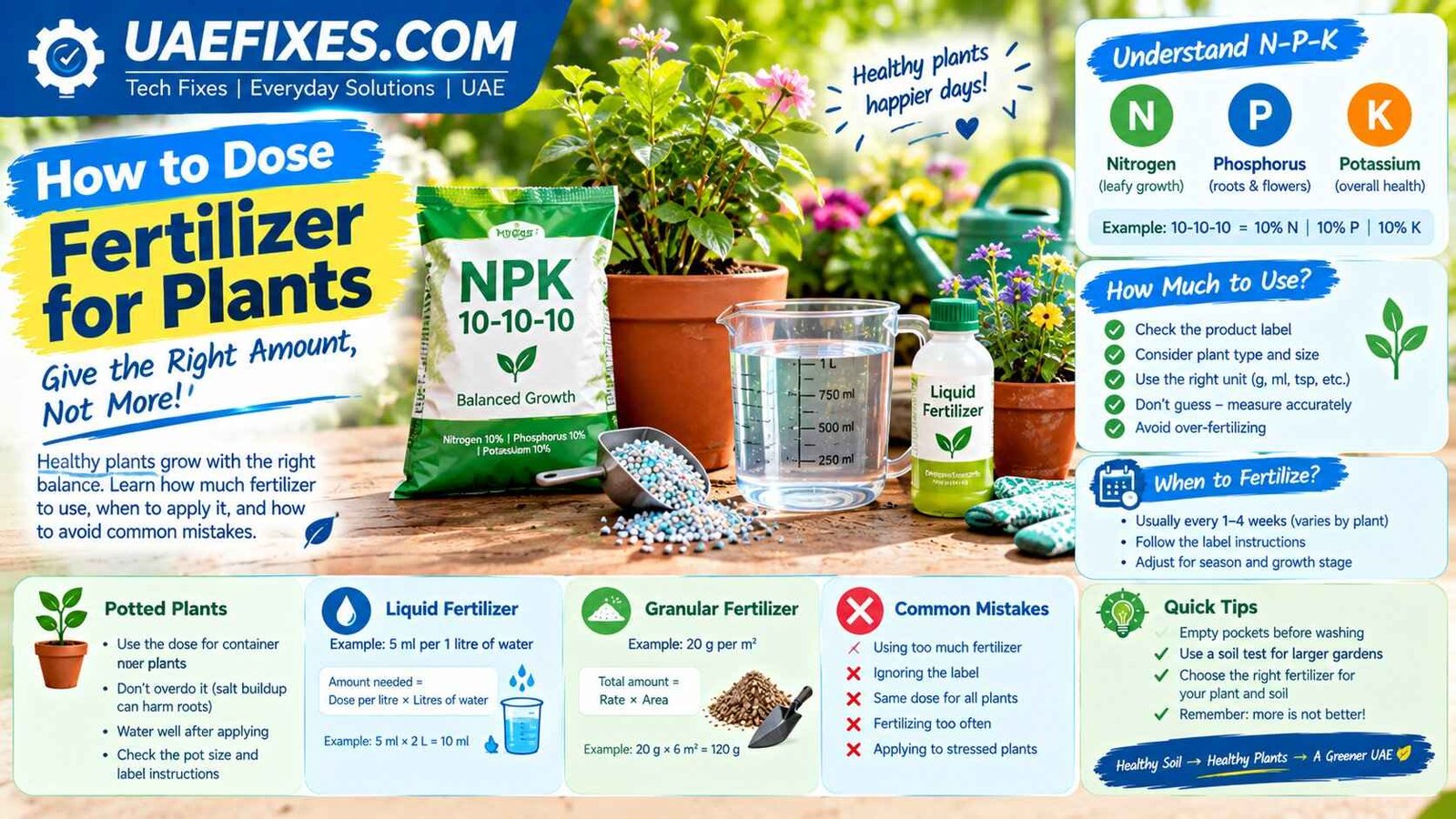
First, Check the N-P-K Numbers
Look at the three numbers printed on the fertilizer package.
For example:
10-10-10
These represent:
- N — Nitrogen: supports leafy growth
- P — Phosphorus: involved in root growth and reproduction
- K — Potassium: supports overall plant function and stress tolerance
The numbers represent the percentages of nitrogen, phosphate, and potash listed in the fertilizer grade.
Another example is:
20-10-20
This fertilizer contains a higher percentage of nitrogen than a 10-10-10 product.
That means you should not automatically use the same amount of both products.
How Much Fertilizer Should You Use?
There is no single fertilizer dose that works for every plant.
Before applying fertilizer, consider:
- What plant are you feeding?
- Is it indoors or outdoors?
- Is it in a pot or in the ground?
- What fertilizer are you using?
- What is its N-P-K ratio?
- Does the label provide a dosage?
- Does the soil need additional nutrients?
- Is the plant actively growing?
If the fertilizer label says 5 ml per litre of water, don’t increase the concentration because the plant looks weak.
A weak-looking plant may have a nutrient deficiency—but it could also have a watering problem, root damage, pests, disease, insufficient light, heat stress, or poor soil.
How to Dose Liquid Fertilizer
Liquid fertilizer is usually diluted with water before application.
For example, suppose the label says:
5 ml fertilizer per 1 litre of water.
For 2 litres:
5 ml × 2 = 10 ml
For 5 litres:
5 ml × 5 = 25 ml
The important thing is to maintain the manufacturer’s recommended concentration.
Simple Liquid Fertilizer Formula
Amount of fertilizer = recommended dose per litre × litres of water
So if the recommended dose is 3 ml per litre and you need 4 litres:
3 × 4 = 12 ml
Measure concentrated fertilizer accurately rather than estimating with a random spoon.
How to Dose Fertilizer for Potted Plants
Potted plants need particular care because their roots are confined to a relatively small amount of soil.
Too much fertilizer can accumulate in the growing medium, especially when watering doesn’t flush excess salts away.
For potted plants:
- Check the fertilizer label for container plants.
- Start with the recommended concentration.
- Don’t fertilize every time you water unless the product specifically says to do so.
- Consider the plant’s growth stage.
- Avoid applying fertilizer to severely dry or stressed plants unless the product instructions say otherwise.
- Water appropriately after applying granular fertilizer.
- Watch for signs of fertilizer buildup.
A smaller pot does not automatically mean you should guess a smaller dose. Use the instructions provided for the particular product and plant type.
How to Dose Granular Fertilizer
Granular fertilizer may be measured by weight or volume.
The package might say something like:
Apply X grams per square metre.
First calculate the area.
For a rectangular garden:
Length × Width = Area
For example:
A garden measuring 2 metres × 3 metres:
2 × 3 = 6 square metres
If the label recommends 20 grams per square metre:
20 × 6 = 120 grams
So the total application would be 120 grams.
Always use the actual rate on your fertilizer label or soil-test recommendation.
Why Measuring Fertilizer Matters
Eyeballing fertilizer is one of the easiest ways to apply too much.
A small kitchen spoon, handful, or cup isn’t necessarily an accurate measurement.
For concentrated fertilizers, use an appropriate measuring tool and follow the product instructions.
This becomes particularly important when using fertilizers with high nutrient concentrations.
Can You Use Less Fertilizer?
Sometimes gardeners assume that using a little more is safer because plants need nutrients.
But fertilizer isn’t like ordinary plant food where more automatically produces better results.
Penn State Extension notes that exact measurement is important because excessive fertilizer can burn roots and stunt plant growth.
If you’re unsure about the correct dose, don’t automatically increase it.
Instead:
- Read the label again.
- Check whether the product is concentrated.
- Check your plant’s requirements.
- Consider a soil test.
- Ask the fertilizer manufacturer or a qualified horticulture professional.
How Often Should You Fertilize Plants?
The correct frequency depends on the fertilizer and plant.
Some fertilizers are designed for:
- Weekly feeding
- Every two weeks
- Monthly feeding
- Slow-release feeding over several months
- One or two seasonal applications
Don’t combine the frequency from one fertilizer with the concentration of another.
For example, a liquid fertilizer designed for weekly diluted feeding is not necessarily suitable for monthly application at the same concentration.
Fertilizer for Indoor Plants
Indoor plants often grow more slowly than outdoor plants because their light levels can be lower.
Instead of automatically increasing fertilizer when growth slows, check the basics first:
- Light
- Watering
- Drainage
- Pot size
- Root health
- Pests
- Temperature
- Soil condition
If those factors are suitable, follow the fertilizer’s indoor-plant dosage.
Fertilizer for Vegetables
Vegetables have different nutrient requirements depending on the crop and growth stage.
Leafy vegetables, fruiting vegetables, root crops, and legumes do not necessarily need the same fertilizer program.
A soil test can help determine which nutrients are actually needed rather than applying fertilizer blindly. University extension guidance recommends using soil-test results to make more targeted fertilizer decisions.
Fertilizer for Flowering Plants
Flowering plants need adequate nutrition, but adding extra fertilizer simply because a plant isn’t flowering may not solve the problem.
Flowering can also be affected by:
- Insufficient sunlight
- Incorrect pruning
- Temperature
- Watering
- Plant maturity
- Variety
- Seasonal conditions
Check those factors before increasing the fertilizer dose.
What Does “Half Strength Fertilizer” Mean?
You may see gardening advice recommending fertilizer at “half strength.”
This generally means using half the concentration specified for the normal application, but you should only do this when the product instructions or a reliable plant-care recommendation supports it.
For example, if the normal label concentration is:
4 ml per litre
Half strength would be:
2 ml per litre
Don’t assume half strength is appropriate for every fertilizer or plant.
How to Calculate Fertilizer From an N-P-K Requirement
For more advanced gardening, you may need to calculate the amount of fertilizer required from a nutrient recommendation.
The basic concept is:
Fertilizer required = nutrient required ÷ nutrient fraction in the fertilizer
For example, if a recommendation requires 1 kg of nitrogen and your fertilizer contains 10% nitrogen:
1 ÷ 0.10 = 10 kg of fertilizer
This type of calculation is useful for larger gardens and agricultural applications.
University of Minnesota Extension uses the same basic principle: divide the required amount of the actual nutrient by the nutrient concentration in the fertilizer.
Do You Need a Soil Test?
If you’re fertilizing a large garden, lawn, vegetable plot, or repeatedly trying to correct plant problems, a soil test can be extremely useful.
A soil test can show whether nutrients such as phosphorus and potassium are already present at adequate levels.
That matters because adding fertilizer that the soil doesn’t need can lead to unnecessary nutrient buildup and environmental problems.
For a single houseplant, a soil test may be unnecessary. For a larger growing area, it can make fertilizer decisions much more precise.
Common Fertilizer Mistakes
1. Using more because the plant looks unhealthy
The problem may not be fertilizer deficiency.
2. Ignoring the label
Different products have different concentrations.
3. Using the same dose for every plant
A tomato plant, houseplant, lawn, and flowering shrub don’t necessarily have the same requirements.
4. Fertilizing too frequently
Frequent applications can cause nutrient buildup.
5. Applying fertilizer to stressed plants
Heat, drought, root damage, pests, or disease may be the real problem.
6. Guessing measurements
A measured dose is safer than a random handful.
7. Choosing fertilizer only by the highest N-P-K numbers
A stronger-looking fertilizer isn’t automatically the right fertilizer.
Quick Fertilizer Dosing Checklist
Before fertilizing, ask:
- What plant am I feeding?
- What fertilizer am I using?
- What are its N-P-K numbers?
- What dosage does the label recommend?
- Am I measuring the fertilizer accurately?
- How much water or growing area does the dose cover?
- Does the plant actually need feeding?
- Could the problem be caused by water, light, pests, or roots?
- Is the plant already stressed?
- Would a soil test help?
Fertilizer Dosage Examples
| Situation | What to Check |
|---|---|
| Indoor plant | Product dose for houseplants |
| Potted plant | Pot size and label instructions |
| Vegetable garden | Soil test and crop requirements |
| Lawn | Area and recommended application rate |
| Liquid fertilizer | ml per litre |
| Granular fertilizer | grams per area |
| Slow-release fertilizer | Release period and label rate |
| Weak-looking plant | Diagnose the cause before feeding |
What Happens If You Use Too Much Fertilizer?
Over-fertilization can cause symptoms such as:
- Brown or burned leaf edges
- Wilting
- Poor growth
- Leaf discoloration
- Salt buildup in soil
- Root damage
However, these symptoms can have several causes, so don’t automatically assume fertilizer is responsible.
If you suspect over-fertilization in a potted plant, stop adding fertilizer and review the product instructions and the plant’s care requirements. If the problem is severe, seek advice from a qualified horticulture professional.
Frequently Asked Questions
How much fertilizer should I give my plants?
Use the dosage specified for your particular fertilizer and plant. There is no universal dose that works for every plant.
How do I calculate liquid fertilizer?
Multiply the recommended amount per litre by the amount of water you are preparing.
Is more fertilizer better for plants?
No. Excess fertilizer can damage roots and may stunt plant growth.
What do the three fertilizer numbers mean?
They indicate the fertilizer’s N-P-K analysis: nitrogen, phosphate, and potash percentages.
Should I fertilize a sick plant?
Not automatically. First determine whether the problem is actually a nutrient deficiency. Watering, light, pests, disease, temperature, and root problems can produce similar symptoms.
Should I use fertilizer every time I water?
Only if the product instructions specifically recommend that schedule and concentration.
Final Thoughts
Learning how to dose fertilizer for plants is mostly about measuring rather than guessing.
Start with the fertilizer label, understand the N-P-K numbers, calculate the amount of water or growing area involved, and use an accurate measurement. For larger gardens, a soil test can make your fertilizer decisions much more precise.
And remember the simplest fertilizer rule: more is not necessarily better. Give the plant what it needs—not what you think it might need.