How to Make a Natural Hand Sanitizer: Safe Alternatives and What Actually Works
When you search for how to make natural hand sanitizer, you will find plenty of DIY recipes using aloe vera, essential oils, alcohol, witch hazel and other ingredients.
The problem is that making something that feels like hand sanitizer is very different from making something that can reliably reduce germs.
If you’re looking for a simple, natural option for everyday hand hygiene, there is a much safer place to start: soap and water. When that isn’t available, an alcohol-based hand sanitizer with the correct alcohol concentration is the recommended alternative.
Safety Note
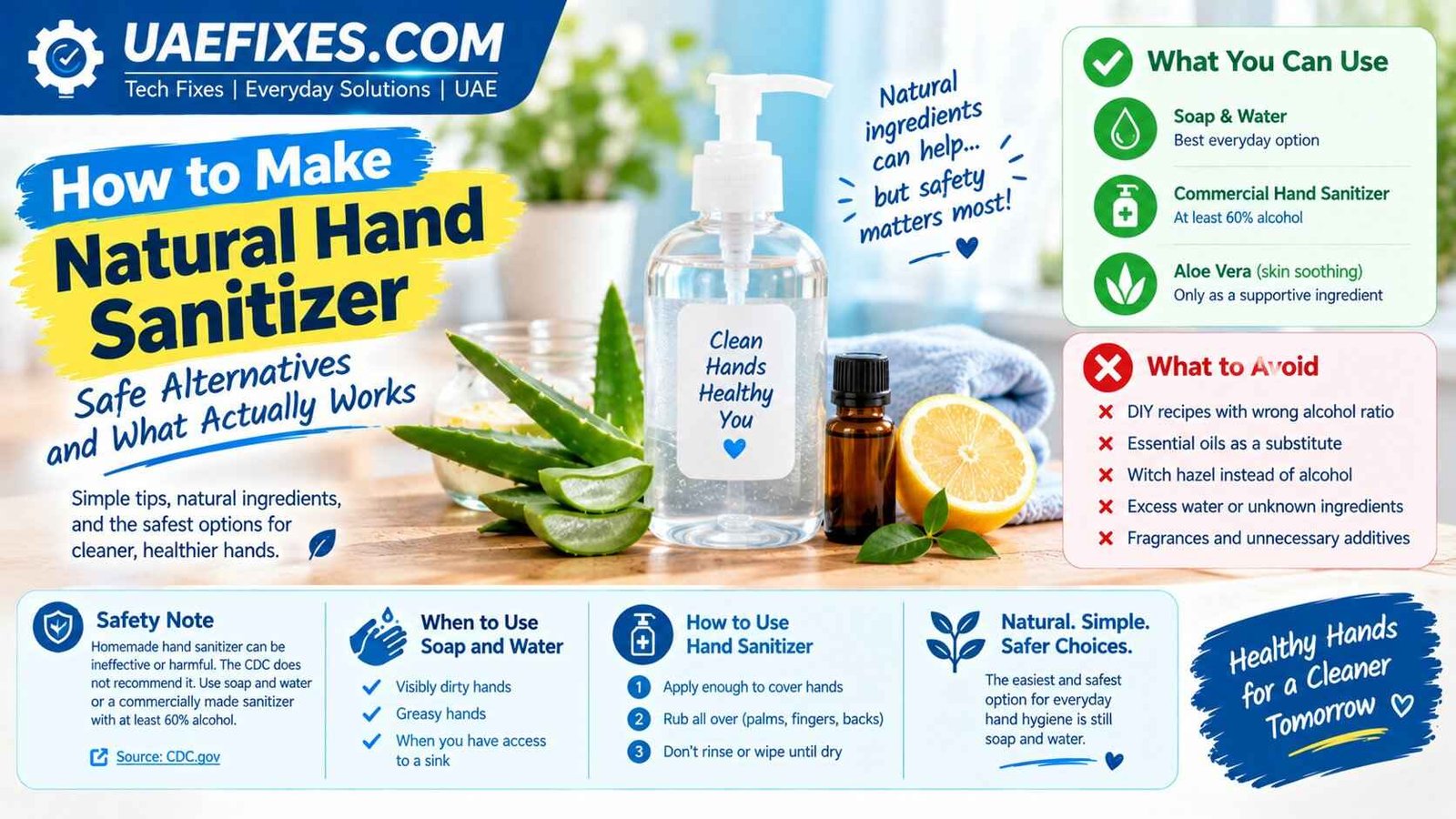
Homemade hand sanitizer can be ineffective or harmful if the ingredients are measured incorrectly or contaminated. The CDC does not recommend producing, using or selling homemade hand sanitizer because achieving the correct formulation and appropriate production conditions can be difficult.
For routine hand hygiene, wash your hands with plain soap and clean running water whenever possible. If soap and water are unavailable, the CDC recommends an alcohol-based hand sanitizer containing at least 60% alcohol.
Do not rely on essential oils, aloe vera or other “natural” ingredients as substitutes for an effective alcohol-based sanitizer. For additional guidance, see the official World Health Organization handrub formulation guidance.
UAEFIXES.COM focuses on practical solutions, but when a homemade product is intended to protect against germs, getting the formulation wrong isn’t worth the risk.
Can You Make Natural Hand Sanitizer at Home?
The short answer is: be careful with the word “natural.”
A product can contain natural ingredients and still not be an effective hand sanitizer.
For example, adding essential oils to aloe vera gel may create a pleasant-smelling hand gel, but that doesn’t mean it has been proven to work as a hand sanitizer.
The ingredient that matters most in an alcohol-based sanitizer is the alcohol concentration.
The CDC recommends hand sanitizer containing at least 60% alcohol when soap and water aren’t available.
The Safest Natural Option: Soap and Water
If your goal is to avoid unnecessary chemicals, plain soap and water are actually one of the simplest choices.
You don’t need:
- Essential oils
- Perfume
- Special antibacterial soap
- Homemade mixtures
- Complicated ingredients
Wash your hands thoroughly with plain soap and clean running water.
This is especially important when your hands are visibly dirty or greasy because sanitizer isn’t a replacement for proper handwashing.
What About Aloe Vera Hand Sanitizer?
Aloe vera is commonly included in DIY recipes because it can make an alcohol-based mixture feel less drying.
However, aloe vera itself isn’t what makes a sanitizer effective against germs.
The final alcohol concentration still matters.
Adding too much aloe vera, water or another ingredient can dilute the alcohol and potentially make the final product less effective.
That’s one reason simply mixing alcohol and aloe vera by eye isn’t a reliable approach.
What About Essential Oils?
Essential oils such as tea tree, lavender, peppermint and eucalyptus are often promoted online as natural alternatives.
They may smell pleasant, but you shouldn’t assume that an essential-oil mixture is an effective substitute for an alcohol-based hand sanitizer.
The WHO’s recommended formulations specifically identify the required active alcohol concentration and other components rather than suggesting essential oils or fragrances. WHO also advises against adding fragrances because of the potential for allergic reactions.
What About Witch Hazel?
Witch hazel is another popular ingredient in homemade “natural sanitizer” recipes.
But witch hazel should not be treated as an equivalent replacement for an alcohol-based hand sanitizer containing the recommended alcohol concentration.
If you’re trying to reduce exposure to unnecessary ingredients, plain soap and water remain the simpler option.
What Makes Hand Sanitizer Effective?
For an alcohol-based hand sanitizer to work properly, the formulation matters.
The CDC recommends a sanitizer containing at least 60% alcohol when soap and water are unavailable.
That doesn’t mean that simply pouring a high-strength alcohol into a bottle automatically creates a safe finished product.
The concentration can change when other ingredients are added.
This is why homemade recipes that say things like “add some alcohol and aloe gel” can be unreliable.
What Is the WHO Handrub Formula?
The World Health Organization has published formulations for local production of alcohol-based handrub.
One formulation produces a final concentration of 80% ethanol, while another uses 75% isopropyl alcohol. The formulations also include glycerol, hydrogen peroxide and suitable water.
However, this guidance is intended for appropriate local production rather than casual kitchen mixing.
WHO specifies requirements for raw-material quality, alcohol concentration, production, storage, labelling and quality control.
So copying a professional formulation without the ability to verify ingredient quality and final concentration isn’t the same as producing a properly tested sanitizer.
Why Homemade Hand Sanitizer Can Go Wrong
There are several ways a DIY mixture can fail.
The Alcohol Is Too Weak
If the final alcohol concentration falls below the recommended level, the sanitizer may not provide the expected effectiveness.
The Mixture Is Too Diluted
Adding too much water, aloe vera or another ingredient can reduce the alcohol concentration.
The Ingredients Are Poor Quality
WHO guidance emphasizes appropriate-quality raw materials for its recommended formulations.
The Mixture Is Contaminated
Hand hygiene products need appropriate preparation and handling.
The Recipe Uses the Wrong Alcohol
Not every alcohol-containing household product is appropriate for use on skin.
Never substitute industrial chemicals, cleaning alcohols or unknown products simply because the label contains the word “alcohol.”
Is Natural Hand Sanitizer Better for Your Skin?
Not necessarily.
A “natural” label doesn’t automatically mean that a product is gentler or safer.
Essential oils and fragrances can cause irritation or allergic reactions in some people.
Alcohol-based sanitizer can also dry the skin, particularly when used frequently.
If your hands become dry, moisturising regularly can help support the skin barrier.
How to Use Hand Sanitizer Properly
If you are using a commercially produced alcohol-based hand sanitizer, check that the label states an alcohol concentration of at least 60%.
Then:
- Apply enough sanitizer to cover all surfaces of your hands.
- Rub it over your palms.
- Rub between your fingers.
- Cover the backs of your hands.
- Rub around your fingertips and thumbs.
- Continue rubbing until your hands are completely dry.
Don’t wipe or rinse the sanitizer off before it dries.
When Should You Use Soap Instead?
Choose soap and water when:
- Your hands are visibly dirty.
- Your hands are greasy.
- You have access to a sink.
- You’ve handled substances that sanitizer may not remove effectively.
- You need to remove certain germs or chemicals from your hands.
The CDC notes that soap and water are generally the best option for hand hygiene and are more effective than sanitizer for removing certain germs and chemicals.
Can Children Use Hand Sanitizer?
Children can use alcohol-based hand sanitizer when appropriate, but they should be supervised.
Alcohol-based products can be dangerous if swallowed.
Keep sanitizer out of the reach of young children and teach them not to touch their eyes or mouth immediately after applying it.
What Should You Avoid in DIY Hand Sanitizer?
Avoid recipes that rely on:
- Essential oils as the main active ingredient
- Witch hazel as a substitute for alcohol
- Vinegar
- Random alcohol percentages
- Unknown cleaning alcohol
- Excessive water
- Unverified online recipes
- Fragrance added simply to make the product smell better
The biggest mistake is assuming that something that smells clean or feels clean is necessarily disinfecting your hands.
What Is the Best Alternative to Homemade Hand Sanitizer?
For everyday use, keep it simple.
At home:
Use plain soap and running water.
When travelling or outside:
Carry a commercially manufactured alcohol-based hand sanitizer containing at least 60% alcohol.
For children:
Supervise sanitizer use and keep the bottle safely out of reach.
For visibly dirty hands:
Wash with soap and water instead.
Natural Hand Sanitizer: Quick Comparison
| Option | Recommended? | Why |
|---|---|---|
| Plain soap + water | Yes | Best everyday handwashing option |
| Commercial sanitizer ≥60% alcohol | Yes | Useful when soap and water aren’t available |
| Aloe vera + essential oils | No | Not a reliable sanitizer formulation |
| Witch hazel mixture | No | Not an equivalent substitute |
| Essential oils alone | No | Not a proven replacement for alcohol sanitizer |
| Random DIY alcohol recipe | No | Final concentration may be incorrect |
| Properly produced alcohol handrub | Yes, when appropriately formulated | Requires controlled formulation and quality practices |
Frequently Asked Questions
How do you make natural hand sanitizer?
There isn’t a simple natural recipe that can be recommended as a reliable substitute for properly formulated hand sanitizer. Plain soap and water are the safest everyday option. When they’re unavailable, use a commercially produced sanitizer containing at least 60% alcohol.
Can I use essential oils as hand sanitizer?
Essential oils should not be treated as a substitute for an effective alcohol-based hand sanitizer.
Can aloe vera make hand sanitizer?
Aloe vera can be used as a skin-conditioning ingredient in some professionally formulated products, but adding aloe vera to alcohol without controlling the final concentration can make the mixture unreliable.
Is homemade hand sanitizer safe?
It can be risky if the formulation, alcohol concentration, ingredients or preparation conditions aren’t properly controlled. The CDC does not recommend homemade hand sanitizer.
What percentage of alcohol should hand sanitizer have?
The CDC recommends an alcohol-based hand sanitizer containing at least 60% alcohol when soap and water aren’t available.
Is natural sanitizer better than regular sanitizer?
“Natural” does not automatically mean more effective or safer. For germ reduction, the formulation and active ingredient matter more than whether the ingredients are marketed as natural.
Final Thoughts
If you’re searching for how to make natural hand sanitizer, the simplest answer may actually be the least complicated one.
When you have access to a sink, plain soap and water are your first choice. When you’re away from a sink, a properly manufactured alcohol-based hand sanitizer containing at least 60% alcohol is the practical alternative.
DIY recipes can look attractive because they’re inexpensive and use familiar ingredients, but hand sanitizer isn’t an area where guessing the proportions is worth the risk.
When it comes to protecting your hands, simple, tested and properly formulated beats homemade every time.