
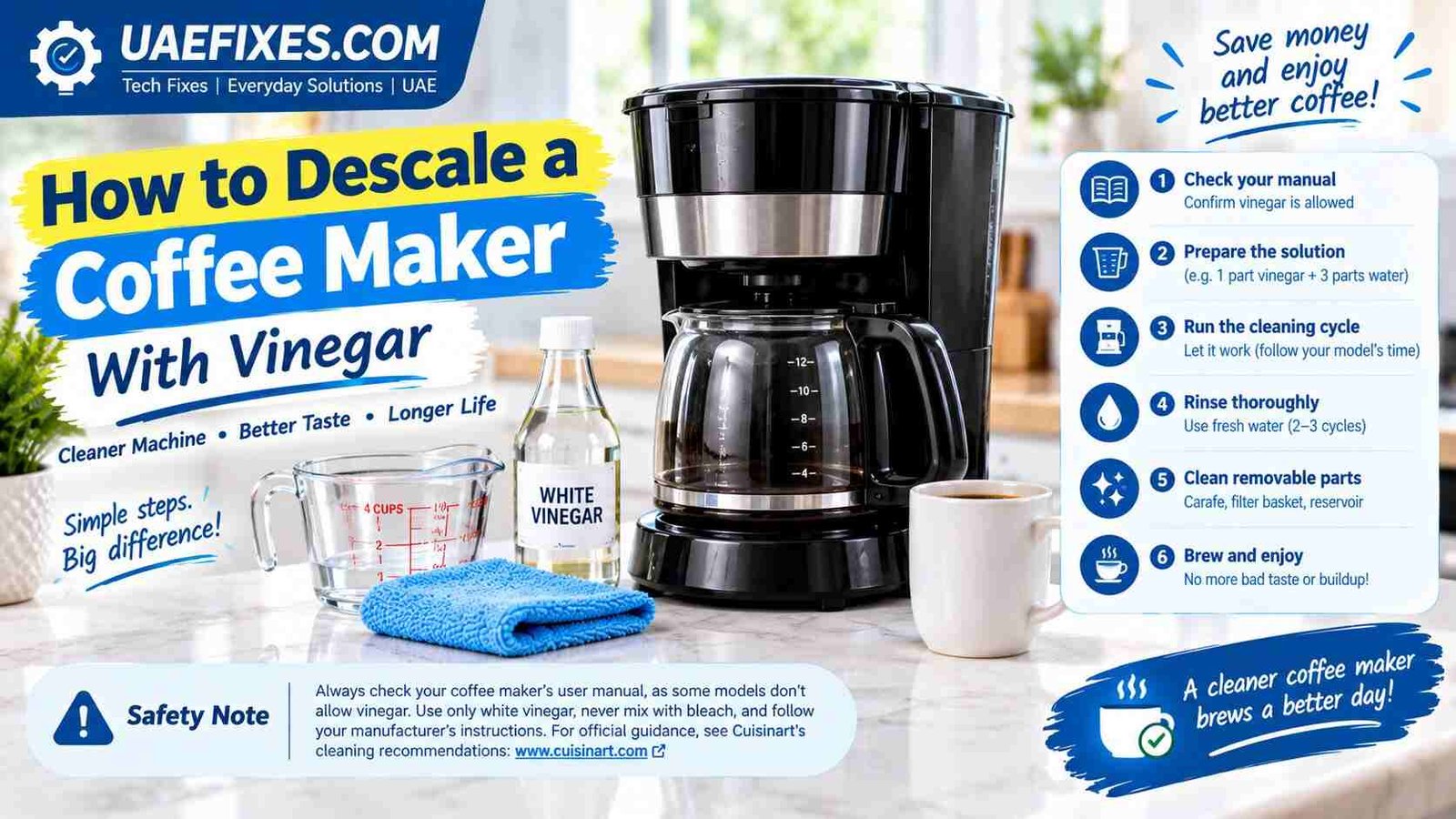
How to Descale a Coffee Maker With Vinegar: Easy Step-by-Step Method
That morning coffee tastes a little different lately.
Maybe it’s weaker than usual. Maybe your coffee maker is taking longer to brew, making strange noises, or leaving you with a cup that has a slightly bitter or unusual taste.
Before you decide the coffee maker is ready for the bin, there may be a much simpler problem hiding inside it: mineral buildup.
Every time water passes through your coffee maker, minerals can gradually collect inside the reservoir, tubes and heating system. Over time, that buildup can affect how the machine works.
The good news? You may not need an expensive cleaning product.
For coffee makers that allow vinegar descaling, ordinary white vinegar and water can help break down mineral deposits and get the machine brewing properly again.
So grab that bottle of vinegar — but don’t pour it into the machine just yet. First, check whether your coffee maker’s manufacturer allows vinegar, because the correct method and mixture can vary by model.
Safety Note: Check Your Coffee Maker’s Instructions First
Before descaling, check your coffee maker’s user manual or the manufacturer’s official cleaning instructions.
Some manufacturers specifically allow white vinegar for descaling, while others recommend a dedicated descaling solution instead. For example, Cuisinart provides vinegar-based cleaning instructions for many of its coffee makers, while Keurig’s instructions vary by brewer model and may recommend its own descaling solution.
You can also check the official Cuisinart coffee maker cleaning guidance or your own manufacturer’s instructions before starting.
Always let the coffee maker cool when necessary, unplug it before cleaning removable parts, and never mix vinegar with bleach or other cleaning chemicals.
For more practical home and everyday solutions, you can also explore UAEFIXES.COM.
Why Does a Coffee Maker Need Descaling?
It’s easy to think that running water through a coffee maker keeps the inside clean.
Unfortunately, that’s not quite how it works.
Water can leave behind minerals such as calcium deposits. Over time, these deposits can build up inside parts of the machine that carry and heat water.
That buildup is commonly called scale.
A heavily scaled coffee maker may experience:
- Slower brewing
- Reduced water flow
- Unusual noises
- Poor coffee extraction
- Changes in taste
- Incomplete brewing cycles
- More frequent maintenance problems
Keurig explains that mineral deposits can build up inside brewers and affect performance, which is why regular descaling is recommended.
Before You Start: Check These 4 Things
Don’t rush into the cleaning cycle.
1. Check the manual
Search for your exact model online or look through the user manual.
Search something like:
“[your coffee maker model] descaling vinegar”
2. Use plain white vinegar
Don’t use flavored vinegar, balsamic vinegar or other specialty vinegars.
You want ordinary white vinegar.
3. Remove coffee grounds
The machine should be empty.
Don’t put coffee grounds or a coffee pod into the machine during descaling.
4. Remove the water filter if required
If your coffee maker has a charcoal or other removable water filter, check the manufacturer’s instructions before running the vinegar cycle.
Cuisinart, for example, instructs users to remove the charcoal water filter during its vinegar cleaning process.
How to Descale a Coffee Maker With Vinegar
The exact vinegar-to-water ratio varies between manufacturers, so follow your model’s instructions first.
For coffee makers that allow a vinegar solution, one commonly used approach is a diluted mixture.
Cuisinart, for example, provides a 3-parts-water to 1-part-vinegar method for many of its coffee makers.
Step 1: Empty the Coffee Maker
Remove:
- Used coffee grounds
- Coffee pods
- Old water
- Removable filters, if the manufacturer’s instructions require removal
Give the carafe and filter basket a quick rinse.
You don’t want yesterday’s coffee joining today’s cleaning experiment.
Step 2: Prepare the Vinegar Solution
For models that specify a diluted vinegar solution, follow the manufacturer’s recommended ratio.
For example, Cuisinart’s general guidance uses:
3 parts water + 1 part white vinegar.
Don’t assume this ratio applies to every coffee maker.
Some models use different amounts, and some manufacturers may not recommend vinegar at all.
Step 3: Add the Solution
Pour the prepared solution into the coffee maker’s water reservoir.
Don’t fill beyond the machine’s maximum fill line.
Place the empty carafe underneath the coffee outlet.
Step 4: Start the Cleaning Cycle
If your coffee maker has a Clean or Descale button, use it according to the manual.
If your model doesn’t have a dedicated cleaning cycle and its manufacturer permits vinegar, you may be instructed to run a normal brew cycle without coffee.
Cuisinart recommends a cleaning cycle for compatible models and also describes a manual brewing method for machines without a clean function.
Step 5: Let the Vinegar Work
Some coffee makers benefit from a pause during the cleaning process.
For example, Cuisinart’s general instructions describe pausing the cycle for around 30 minutes on applicable machines. Hamilton Beach also specifies a 30-minute pause in its vinegar-based descaling instructions for certain models.
But don’t automatically use a 30-minute pause for every coffee maker.
Your model’s instructions come first.
Step 6: Finish the Cleaning Cycle
Allow the machine to complete the manufacturer’s recommended cleaning or brewing cycle.
The vinegar solution will pass through the internal water pathway and help loosen mineral deposits.
When the cycle is finished, empty the carafe.
And no — don’t drink it.
Step 7: Rinse the Coffee Maker Thoroughly
This is the step people sometimes rush.
Don’t.
Fill the water reservoir with clean water and run a full brewing or rinse cycle without coffee.
Then empty the carafe.
Repeat the fresh-water cycles according to your manufacturer’s instructions.
Hamilton Beach, for example, instructs users of certain models to run 2–3 fresh-water cycles after the vinegar treatment.
If you can still smell vinegar afterward, run additional fresh-water cycles.
You want your next cup to taste like coffee — not salad dressing.
Step 8: Wash the Removable Parts
Now wash the removable components according to the manufacturer’s instructions.
This may include:
- Carafe
- Filter basket
- Water reservoir
- Pod holder
- Drip tray
Use warm water and mild dish soap where appropriate.
Rinse everything thoroughly and allow it to dry.
Step 9: Make a Test Brew
Once you’ve finished rinsing, make a plain water cycle first if your manufacturer recommends it.
Then brew your next coffee.
If there is no unusual vinegar smell or taste, you’re ready to go.
How Much Vinegar Should You Use?
This is one of the most important questions — and there isn’t one universal answer.
Different coffee makers use different cleaning procedures.
For example:
Cuisinart: Some models use a 3:1 water-to-vinegar ratio.
Hamilton Beach: Certain models specify plain white vinegar and then multiple fresh-water cycles.
Keurig: Some brewer instructions specifically allow undiluted white vinegar, while other current models recommend Keurig descaling solution.
So the safest answer isn’t:
“Use exactly X cups of vinegar.”
It’s:
Use the amount and method recommended for your specific coffee maker.
Can You Use Vinegar in a Keurig?
It depends on the model.
Keurig has published brewer instructions that include a white vinegar descaling method for certain models. Those instructions can involve multiple vinegar rinses followed by fresh-water rinses.
However, Keurig also recommends its dedicated descaling solution for some current brewer models.
So before using vinegar, check your exact Keurig model’s instructions.
Can You Use Vinegar in a Drip Coffee Maker?
Many traditional drip coffee makers can be cleaned with vinegar when the manufacturer permits it.
Cuisinart, for example, specifically provides vinegar cleaning instructions for standard drip coffee machines and compatible Cuisinart models.
The important part is following the correct ratio and rinse procedure.
How Often Should You Descale a Coffee Maker?
There’s no single schedule for every machine.
It depends on:
- Water mineral content
- How often you use the coffee maker
- The type of machine
- Whether you use filtered water
- The manufacturer’s recommendations
Some manufacturers recommend descaling every few months.
Keurig, for example, recommends descaling its brewers approximately every 3–6 months, while noting that mineral buildup can occur faster depending on water conditions.
If your coffee maker starts brewing more slowly or shows a descale warning, don’t wait for your usual schedule.
Signs Your Coffee Maker Needs Descaling
Your coffee maker may be asking for attention if you notice:
Coffee takes longer to brew
The machine seems to work harder or slower than it used to.
Water flow is weaker
Less water comes through during the brewing cycle.
The machine sounds different
You may hear more humming, clicking or unusual pumping sounds.
Coffee tastes different
Mineral buildup and old residue can affect the brewing experience.
The machine shows a “Clean” or “Descale” warning
If your model has this feature, don’t ignore it.
You can see white or chalky deposits
That’s a classic sign of mineral buildup.
Vinegar Smell Still There? Here’s What to Do
Don’t panic.
It usually means the machine needs more fresh-water rinsing.
Run additional clean-water cycles until the smell disappears.
Some manufacturers specifically recommend additional fresh-water cycles when vinegar taste remains. Cuisinart and Keurig both include additional rinsing guidance in their cleaning instructions.
Don’t Make These Coffee Maker Cleaning Mistakes
A few mistakes can turn a simple cleaning job into a frustrating one.
Don’t use apple cider vinegar
Use plain white vinegar if your manufacturer allows vinegar.
Don’t mix vinegar with bleach
Never mix cleaning chemicals.
Don’t use coffee during descaling
The machine needs to be empty.
Don’t skip the water rinse
This can leave an unpleasant vinegar taste.
Don’t assume every machine uses the same ratio
This is probably the biggest mistake.
Don’t ignore the manual
A manufacturer may specifically recommend a branded descaler instead of vinegar.
Don’t pour cleaning solution into the wrong opening
Only use the water reservoir or cleaning procedure specified by the manufacturer.
Vinegar vs Commercial Descaling Solution
So which is better?
Vinegar
Pros:
- Easy to find
- Inexpensive
- Useful for compatible machines
- Can help remove mineral buildup
Cons:
- Strong smell
- Requires thorough rinsing
- Not recommended for every machine
- May not follow your manufacturer’s preferred method
Commercial descaler
Pros:
- Designed specifically for coffee machines
- Manufacturer-approved for some models
- Often convenient to measure
- May leave less odor
Cons:
- Costs more than household vinegar
- Not every product is compatible with every machine
The best choice is the one your coffee maker manufacturer recommends.
What If Vinegar Doesn’t Fix the Problem?
This is important.
Descaling can remove mineral buildup, but it can’t repair every coffee maker problem.
If your machine still:
- Won’t heat
- Won’t pump water
- Leaks
- Stops halfway through brewing
- Shows repeated error messages
- Makes severe unusual noises
then the problem may be mechanical or electrical rather than simple scale buildup.
At that point, check the manufacturer’s troubleshooting guide or contact an authorized service centre.
Quick Coffee Maker Descaling Checklist
Before you start:
- Check the user manual
- Confirm vinegar is allowed
- Empty coffee grounds or pods
- Remove the water filter if instructed
- Prepare the correct vinegar mixture
- Run the correct cleaning cycle
- Allow the recommended soaking time
- Empty the used solution
- Run fresh-water rinse cycles
- Wash removable parts
- Check for vinegar smell
- Make a test brew
Frequently Asked Questions
Can I descale my coffee maker with white vinegar?
Many coffee makers can be descaled with white vinegar, but it depends on the manufacturer and model. Cuisinart and Hamilton Beach provide vinegar-based cleaning methods for certain machines.
What is the best vinegar-to-water ratio?
There is no universal ratio. For example, Cuisinart recommends 3 parts water to 1 part vinegar for many of its coffee makers, while other manufacturers use different procedures.
How long should vinegar sit in a coffee maker?
It depends on the machine. Some manufacturer instructions include a 30-minute pause, while other models use different timings. Always follow your specific model’s instructions.
How many times should I rinse my coffee maker after vinegar?
Run fresh-water cycles until the vinegar smell and taste are gone. Some manufacturers specifically recommend 2–3 or more rinse cycles depending on the model.
Can I use vinegar instead of coffee maker descaling solution?
Sometimes. It depends on your coffee maker. If the manufacturer recommends a specific descaling product, follow that recommendation instead.
How often should I descale my coffee maker?
Follow the manufacturer’s schedule. Some manufacturers recommend approximately every 3–6 months, but machines used frequently or with mineral-rich water may need more frequent descaling.
Why does my coffee taste like vinegar after descaling?
Usually because the machine hasn’t been rinsed enough. Run additional fresh-water cycles until the smell and taste disappear.
Final Thoughts
You don’t need to replace a coffee maker just because your morning brew suddenly tastes strange or the machine has started brewing slowly.
Sometimes, it simply needs a good descaling.
If your manufacturer allows vinegar, the process can be surprisingly simple: prepare the correct solution, run the cleaning cycle, let it work for the recommended time, and — most importantly — rinse the machine thoroughly afterward.
And remember the golden rule:
Don’t follow a random vinegar recipe just because it worked for someone else’s coffee maker.
Check your model first.
A five-minute search for the manufacturer’s instructions can save you from damaging an expensive machine — and help you get back to the important part: good coffee.